Come What May
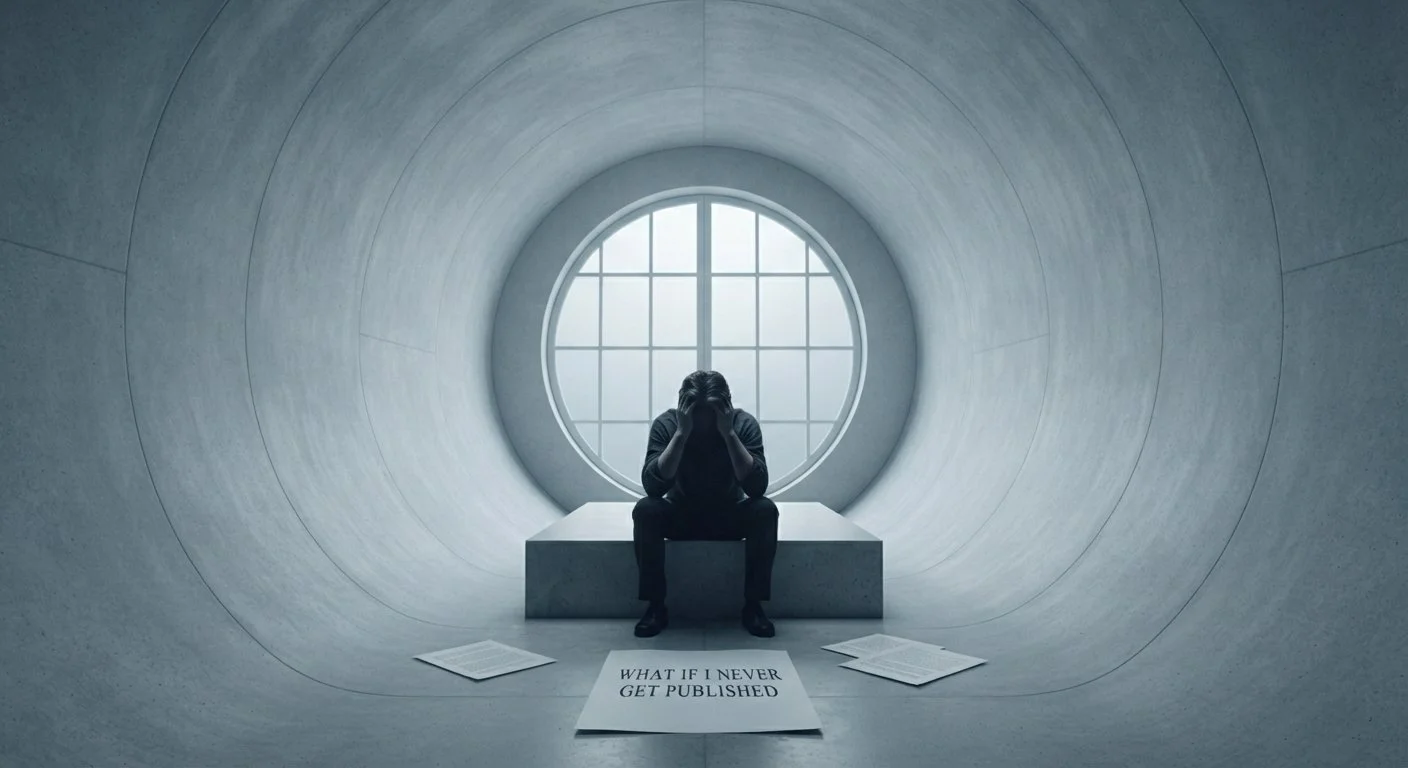
Somewhere in a box in my garage is a plaque that says, 'Editor's Award' for a short story that I wrote in fifth grade about a family's adventure camping on a mountain. It is the only award I've ever won in my life. From that moment on, I dreamed of becoming a published author.
In middle school, creative writing assignments became ambitious story projects, and throughout high school I spent hours writing stories, scripts, and attempts at books. When it came time to choosing a career, I chose teaching–not because it was what I was drawn to or had ambitions to become (even though teachers were my heroes throughout my education)--but because it was the one career that seemed to fit the life of a writer better than any other. My creative writing teacher in high school said as much–the way it allowed you to live in the universe of reading and writing while giving you time to breathe creatively in the summer.
Besides, while I've always been an idealist, I'm no fool. I knew you just didn't make it as a best-selling author overnight. And even if I held this belief secretly (and continue to today), I was never going to bet my future livelihood on it. Since writing was such a passion and talent, I briefly considered choosing a non-fiction writing career such as journalism, but quickly dismissed it so that my day job didn't rob the joy of my passion for wordsmithing.
During my junior year of high school, I met my current co-publisher and became best friends, and we knew, above anything else about our future: we would one day be realpublished authors with book deals and nagging agents and a devoted fanbase. Our satirical vision of our outlandish dreams was walking into an agent's office with a massive printed manuscript the size of a triple-layered cake and slamming it on his desk and saying, with Hemingway-ish gusto, "There! It! It's done!" and then storming out of his office as if we had done the favor of writing a masterpiece he didn't deserve. It's still something we laugh about thirty years later, but perhaps with a little less reckless humor.
When we were in high school and college (the grungy 90's) there wasn't such a thing as self-publishing to distract us from our ambitions–or at least the vanity presses that did exist were a guilty pleasure experienced by a shameless few. Why were we so sure of ourselves and our dreams? To put it simply, we loved novels, we loved to talk about novels and write stories, and our teachers only enabled us by telling us we were talented (the worst thing by the way for a writer is to feed his ego. A writer, an artist of any kind, needs to starve and feel the isolation and horror of silence to drive you towards improvement and time working on your craft).
But here is the problem for any writer with ambitions of writing fiction as a trade: There is no career ladder, college degree, application, certification, or interview to land you an agent and a book deal. Yes, there are MFA programs (something I did in my 40s just for the heck of it), but these don't teach you the writing trade. Actually, the trade of writing is frowned upon by MFA programs, which focus far more on the art of writing and developing a specific kind of literary writer, and in many ways deny the validity of genre writing, or at least of writing that falls outside the criteria of book club trends or English professor-approved aesthetics.
So even though I dropped about 40 grand on an MFA, I did not come away with any better understanding of the writing trade than I had before. Actually, I didn't even come out of my MFA with more than one or two very short stories that I still think are decent. I did, however, get to read a lot of bad writing because apparently the threshold for quality writing was not very high, despite the program's application process. I don't regret getting the degree because it made me more money as a teacher, but I digress.
The point is that, unlike teaching, which has a clear track with a college diploma and a license that set you up for interviews with school districts (jobs that are not that hard to come by if you do what it takes to become a teacher), there's no such linear career path for an author. If there were such a path, I would have taken it by now. Like my career in education, I would be an established author. Let me be clear: I don't think I'm the most talented writer in the world, or the smartest person in the world, or or even the hardest worker, but I believe I'm good enough in all three areas to achieve whatever career goal I have ever set in front of me. So why didn't it happen with writing?
At fifty, I have the same dream, and nothing I have accomplished professionally has substituted for this dream or dulled its desire. I hoped that perhaps self-publishing would help scratch this itch when it came to seeing my writing exist in the world outside my own laptop and notebooks, and Amazon KDP has decreased the friction of self-publishing to such a degree that it's a hard option to pass up, especially since so many hacks and non-writers are using AI to publish dozens of books a year. It's gotten to the point that Amazon has just decreased the number of titles you can publish a day by two. Think about that for a second. So many non-authors are publishing books and flooding the Amazon digital bookshelves that they had to limit the number of books to two a day. And I'm sitting here trying to work my way to the point where I can get a single book traditionally published!
Back in 2023, my co-author and I were kind of freaking out about the exponential increase of the slush pile of bad writing out there. It felt like trying to surf a wave with thousands of boogie boarders in your path. How can you even get on your feet? How can you have a voice? Who is going to care?
I will leave this existential crisis for a different blog, but over the next three years, my co-publisher and I got over this anxiety and decided to move forward with a blended approach of self-publishing, content creating, and becoming traditionally published, come hell or high water. But the problem with becoming a published author all along is that I never really knew or understood the hoops, professional tasks, and moves I needed to make to realize this dream. Decades later, I now understand that, even though there's not a linear path, there are specific steps you can definitely take.
I wish somebody in college, or in one of my two degrees that had to do with writing, had come along and laid out at least a semi-linear plan, like the following:
First figure out a manuscript you're going to focus on that has a specific audience in mind.
Now read the best fiction in that genre, not to copy it, but to sharpen your own sense of quality writing and to expand your own capacity in terms of what a good book in that genre can be.
Then work on your manuscript until it is amazing, give it to a small group of beta readers who you trust will give you honest feedback, and continue to develop the manuscript.
Once you feel like you have it, take the next step by going through the process of querying a literary agent. To find the right literary agent, go to this resource, or this resource, or this resource. Keep at it relentlessly until somebody gives you enough feedback to either keep trying literary agents or go back to your manuscript and improve whatever the industry is telling you it lacks. Then send it back in, or send it to another agent.
After enough dead ends, find somebody in the industry or among your own circle who can tell you whether this manuscript is actually going to get you a literary agent and get you published, or whether it was just part of your own learning process as a blossoming writer, and maybe you need to start from scratch with a new manuscript.
Rinse and repeat until you get a literary agent who will work with you to get your manuscript where it needs to be until it is published.
I'm not saying this is a path that guarantees anybody will become published, but at least it's something! I needed some strategy, any strategy, rather than just writing and wondering if I would ever be good enough to become published. Actually, I mention in my writing book that back in the early 2000s I had one interaction with a publisher who did not like the middle-grade book I was writing. It crushed me, and rather than taking away real lessons on how to improve my strategy going forward, it fed my self-doubt and decreased my efforts going forward.
I now realize there are many other paths to becoming traditionally published. Sometimes people are just plain lucky. Sometimes people are just plain talented beyond their years. Sometimes somebody just has the right idea at the right time, and the right person reads it. And sometimes it takes years of following a real strategy until you break into the industry.
Any course of action is actually better than the alternative, which scares me to death: that after years of going about it the wrong way, and now years of going about it the right way, I won't get that agent and, consequently, won't get that book deal. That is my greatest fear as a writer, the universe telling me that my fifth-grade dream was a lie, a deception, a false perception of both my gifting and my purpose.
That is not to say that becoming a published writer is the be-all and end-all of my existence. Far from it. I am 50 years old with a beautiful family, living in our dream place and a life full of so many blessings that it is a sin to complain. But I would be lying if I said I wouldn't be crushed if I left this earth without ever having a manuscript of mine published by an actual publishing house. All the time I've spent and all the dreams I've had would feel like a waste. It's a frightening thought when you think about it: you've dared to dream something for so long, and it might never happen. And if we're honest with ourselves as unpublished authors, this is a real possibility.
Let me end this blog with silver linings that should keep things in perspective no matter the outcome of never becoming published. Sometimes our dreams push us forward and give us hope, and we end up in sunny meadows we didn't intend to discover, and where we end up professionally and personally is beautiful and fulfilling all the same. Another real possibility: Sometimes we misjudge our abilities and talents, or at least their relevance in the world, and maybe we either don't have enough talent to become marketable, or we don't have enough time to develop our writing to become marketable. And sometimes writing is a labor of love that we will do no matter what comes of it. We write the rest of our lives because that is who we are and what we do in our free time. For example, when I write, I am so engrossed in the moment, and my brain is so electrified by the translation of images and feelings and characters into words that I can't imagine life without that experience. And another possibility of the unpublished author: Sometimes we have what it takes, enough talent to improve, but we were just never consistent enough, confident enough, or self-disciplined enough to turn that craft into a profession.
I choose to believe I am in this last category at this point. I know more now, so I need to do more now, and do it more consistently. So yes, I will face my greatest fear and follow my greatest dream, come what may.